Wednesday, March 25, 2015

Europa Park!

Last weekend I had the pleasure of joining Erika's family to visit Europa Park, one of Europe's biggest (if not the biggest) amusement parks.  Erika's mom got 4 free tickets from her work, including 40 euros worth of food vouchers, and she asked Erika and I to join her and her partner Sven.  Score. Also it was approximately one hour away from Erika's family's apartment by car. Double score. I hadn't been to an amusement part since the 8th grade trip to Adventureland, but Europa Park was a huge step up. Roller coasters are awesome, and they had a few big ones. Probably not as awesome as Cedar Point or whatever it is in Ohio, but that's a pretty American thing to do, have the biggest and fastest of something. Europa Park is smaller in size most likely, but with much more style, probably. It's divided into 13 different countries, with different architecture, styles, and attractions to match the country. Iceland was pretty awesome because thats where all the new roller coasters were, not sure why though. Also interestingly enough, the newest roller coaster located in between Iceland and Russia was built with money from the Russian gas company, Gazprom and was title "Blue Fire". They had a fancy little Gazprom exhibition hall with company propaganda and an 8 man foosball table and bouncing techno music for the entire roller coaster queue.


The entrance at 9am. It was probably high of 50F and overcast the whole day. I could start a roller coaster feeling reasonably warm, but by the time it was over I was shivering and with a wet stripe of tears from the edge of my eye to my ears.


Here is one of the roller coasters, the Silver Star. An oldie, but a goodie. That way up was very slow and suspenseful the first time around, but the drop was awesome. 


The Grimm Bros. area, mostly for kiddie rides on mushrooms and the like


I thought this was a pretty cool design for a toilet...


Italy


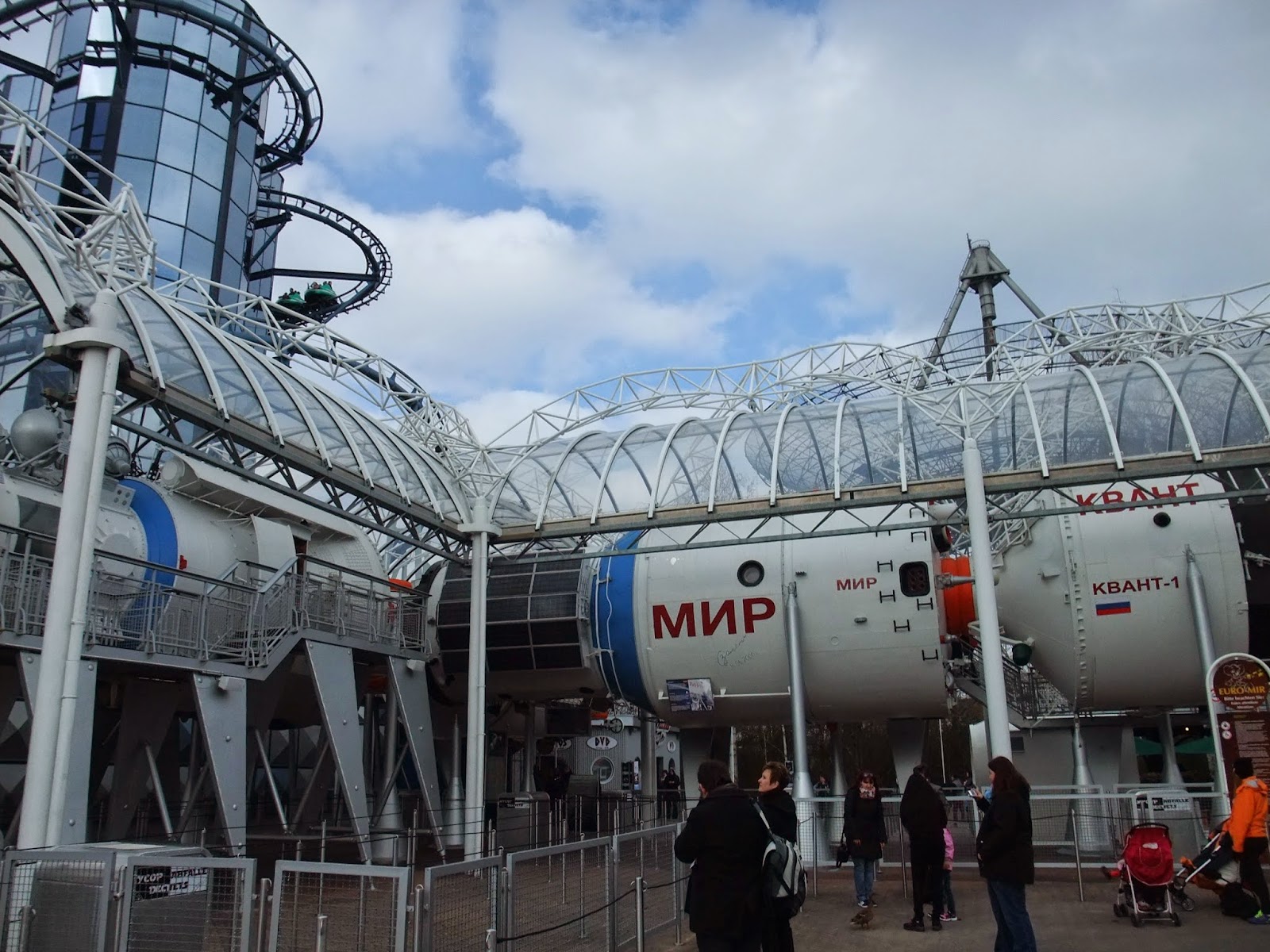
The Russian area was really cool. A couple roller coasters (top left corner) and directly in front is a model of the Mir station, I think. Still not sure how legit it was but it had some signatures painted on the side and some biographies inside.  


Kremlin gateway to Russland.


Finland


This big ball in France actually had a roller coaster inside of it. It was space themed and simulated a blast off. It was also awesome because of the techno music, spacemen, and because it was pitch black inside except for the strobe lights.  And the big bow tie was added this year to celebrate Europa Parks 40th anniversary this year.


Portugal's water coaster. It was fun, but quite cold afterwards. You can see the splash in this picture. Best part was that there was no line.


They even had a little parade rolling through the main streets. It's hard to see from the picture, but that girl is waving a Netto flag. Netto is a discount grocery store that Erika's mom works at once a week, and they were the ones sponsoring all the free tickets. There were hundreds of flags and banners around the park because it was "Netto Employee Appreciation Day" or something, so the park was opened specifically for Netto employees and families. I used to shop at a Netto in Erfurt and thought it was a pretty good grocery store, and now that I got some roller coaster rides out of it too, Netto just moved up a few places in the grocery store hierarchy. Aldi is shit. 


Moving into Bonn

I'm about 3 weeks late to post about our my recent move to Bonn, but I think its time I share some photos of our new place.  It's almost double the size of our old apartment, which means we had a lot of empty space when we first moved in, but after finding a new couch and a bigger dining table, the space is starting to fill up. I have no doubts that we will manage to fill it up with more side tables, comfy chairs, and lamps in the upcoming months.


When you move into a new apartment in Germany, its pretty typical not to have anything in your kitchen. No refrigerator, no oven, no sink.


Here is our sink sitting on a lawn chair in our living room. I now understand why Ikea is so damn popular in Europe: because that is the only cheap store around where you can buy your sink. 


You even have to buy countertops. From Ikea, and they only come in dimensions of 2.4m x .6m.  For reference 2.4m is almost 8 feet long. Way too long to put in a common elevator, which means carrying it awkwardly up 7 flights of stairs to your apartment.


This is after I installed the light fixture, because normally there is just a little box you have to wire your lights to. 


But at least the apartment has nice big windows facing south-westish. All that beautiful sunlight is shining on our new couch we picked up for free from down the street.  Getting it home was a bigger challenge than expected, but that story is better when I tell it in person. 


And the view from the window is pretty nice. There are some nice jogging paths up the hill by that mansion-apartment building. I went there a few days ago and it was still in its gross, muddy spring phase, but it could be nicer in the summer.


And the view from the top of the hill has a nice view over south Bonn and our neighborhood, Kessenich. All these buildings are pretty close to the Rhein river, on the far left is a UN headquarters, the tall dark one is the DHL headquarters, and the white, industrial tower is the Haribo gummy factory. Sometimes when I bike down to the river I can smell the licorice.

When the weather improves I will take some more pictures of our neighborhood. It's really nice and convenient with grocery stores, banks, pharmacies, cafes, tram lines, and a gelato shop within a couple minutes walk.  It's a real cute little neighborhood.


Monday, March 2, 2015

Net neutrality update

Good evening! A few days was a big day for Americans in the World Wide Web, when the FCC passed a vote to include high speed Internet as a common carrier under Title II of the Communications Act. This was the most important story of Feb. 26th, making headline news all across the country until that stupid "what color is this dress" thing came out of nowhere. Anyways, I just spent my last week writing about net neutrality for class, and I thought I should share some of my conclusions about what this net neutrality thing means for us. I won't talk much about the history, but more about what the FCC actually voted for and how we might be affected.

Firstly, I want to point out that when I say for net neutrality, I mean for Title II classification.  That is what we've really been talking about the whole time, should broadband Internet be classified under Title II or should it be left as is, under Title I. I make this point because all the big companies who have been named and shamed as "against net neutrality" have all made it quite clear that they are not "against" net neutrality, they just have a different vision of what that means than the people who are typically "for" net neutrality.  You can imagine what kind of political/economic blunder it would be for someone or some company to say they are against net neutrality, meaning they are against open and free Internet. C'mon, this is America we're talking about, you can't not love freedom. We just have a whole helluvalotta ideas about what freedom means, and it shows in more places than Internet policy.

Okay, so that's cleared up. What did the FCC sign when they signed the Open Internet Order? Here is an excerpt from my paper. I did some editing of the less important stuff. Warning! Lots of text incoming! (PS I removed my in-text citations to make it shorter/easier to read. I have evidence for the things I'm saying!)

 "The proposal adopted on February 26th, 2015 reaffirmed the core principles established in the 2010 Open Internet Order, that broadband providers cannot block access to legal content, they cannot throttle (provide slower access) legal content; and they cannot authorize paid prioritization (provide fast lanes) to certain content over others. These three “bright line” rules are a complement to the high transparency provision that survived the 2010 court ruling, and are now the guiding principles for an open Internet. These rules will also apply to mobile broadband, something that the original Open Internet Order did not include in 2010. 

The FCC plans to regulate Internet service according using a combination of so-called “light touch” Title II regulations, and complementing it with its previous regulatory powers from Section 706 of the 1996 Telecommunications Act.  This provides the FCC the legal authority to maintain an open Internet, along with the flexibility to encourage investment and growth. Title II regulation was originally conceived in the 1930s, so the FCC will use its power to forebear, or not act upon, on over 700 regulations that do not pertain to modern Internet technology. However, it will enforce the regulations that pertain to protections against discrimination, protecting people with disabilities, open access to utility poles to competitors, and retain the power to levy taxes for infrastructure development. All the important things that the majority of people wanted. 
The statement also highlighted some key Title II provisions the FCC will not enforce in an effort to assuage the fears of many broadband providers. These include: Stating that it will not establish any sort of rate regulation or last-mile unbundling, that it does not require broadband providers to contribute to the Universal Service Fund (even though the FCC retains the power to do so under Title II), and that there will be no additional state and local taxes on broadband service. The FCC grants ISPs with significant powers to manage their network according to their technological needs, as long as the management pertains to legitimate network interests, rather than business interests. 
Lastly, and perhaps most interestingly, the FCC now claims the authority to address issues related to interconnections between broadband service providers and other network services.  For the first time, the FCC will now “hear complaints and take appropriate action if it determines the interconnection activities of ISPs are not just and reasonable”." (I'll get into interconnections a little bit later.)

Great! The FCC is going to protect us! All is well in the world! Well not quite. There are still a lot of problems facing the FCC and these rules aren't go to solve them all.  So whats the problem?

"Lawsuits
The next hurdle the FCC must overcome will be the inevitable lawsuits that broadband companies will file against reclassification, or against provisions within the reclassification. Though Title II classifications provide the FCC with the strongest authority to regulate open Internet, there are still some gray areas for cable companies or ISPs to find an incongruous portion of text that can hold up in law.  The exact details of the new rules are not known, and implementation won’t take place for several months, so detailed analis of the the legal challenges is not yet possible.  But one example stands out just in the simplified text released by the FCC, that being the contradiction of FCC power to regulate “interconnections” versus forebearing on rate regulation.
The more commonly used word for interconnection is the term “peering”, where different network actors make agreements to mutually improve access speeds between their networks. Peering is generally viewed positively because both networks benefit from faster access, and many, but not all, of the peering agreements are done without any money exchanging hands. However, free peering is less common in the US than in most places in the world, meaning that networks often extract money from content providers, like Netflix, for improving the interconnections’ flow of data to consumers around country. [Here is a link to a great article about peering. I used it for my research] Under Title II, the FCC has the authority to require fair access and reasonable pricing for interconnections, and in the FCC’s open Internet statement, it declared that it would listen to and enforce claims that the interconnection is not just or reasonable on a case by case basis. However in the case that the FCC finds a paid interconnection to be unjust, it may not be able to enforce its decision to because it has already ceded the power to regulate rates. This kind of mandate discrepancy between different network actors may provide enough wiggle room for lawsuits to split FCC powers under Title II.

Fickle politics
Though most of the power to regulate broadband lay in the FCC, an independent regulatory agency, net neutrality was highly politicized issue.  As mentioned before, approval of the Open Internet Order split 3-2; Democrats to Republicans. FCC commissioner Ajit Pai’s oral statement against the order (2015) explicitly called net neutrality “Obama’s plan to regulate the Internet”. And Obama’s open address to the public in November received considerable backlash from Republicans in Congress.  Senator Ted Cruz, a particularly conservative leader went so far as to Tweet that “Net Neutrality is Obamacare for the Internet; the Internet should not function at the speed of government” Republicans in Congress tried to block open Internet regulation through legislation but failed to do so because it lacked any sort of Democratic support.  This partisan division in Congress and within the FCC shows that net neutrality may be here today, but there is no guarantee it will remain 10 or 15 years in the future.  During Republic leadership in the early 2000s broadband Internet was deregulated in an effort to spur investment, [just the opposite of now]. Net neutrality advocates should be wary that the regulatory pendulum has swung in their favor now, but as markets and technology evolve, the struggle to protect consumers will also evolve.
 [So Leah, to answer your question, the reason it went 3-2 is because of partisanship. Not  a very exciting answer.  The FCC is an independent agency but there is definitely a revolving door with private interests. You vote against Title II, and when you're finished as commissioner you can come and sit on the board of Comcast.  John Oliver mentions that Comcast or telecoms in general are the 2nd biggest spenders in Washington. And I know somewhere in this book by Susan Crawford about Comcast she pegs them as the biggest spender.]

Unbundling the last mile
Perhaps the most damning section of the Open Internet Order is the explicit mention that the FCC will not regulate last-mile unbundling, meaning that competition (or lack of competition) between broadband service providers is not going to change any time soon for the average consumer. Part of the FCC’s mandate is to remove barriers to competition, but at this moment they are avoiding stepping on any more cable company toes. Unbundling the last-mile would require monopoly cable companies to lease the last mile sections of wire to third parties.  Allowing third parties to lease cable means they don’t have to invest in all the expensive sunken costs that attribute to a cable’s natural monopoly position.  Supporters of last-mile unbundling believe this could lead to all sorts of competition as witnessed in the European Union.  As it currently stands the majority of US consumers only have the choice between 1 or 2 service providers they can access at home , but this poor selection of service providers isn’t new to the American public, and the new net neutrality rules don’t suggest any changes are likely to happen soon. 
Even some critics of net neutrality argued that the US wouldn’t need net neutrality guarantees against discrimination if the broadband market had greater competition, and that net neutrality rules are really only applying a bandage to a wound that needs surgery. Effective last-mile unbundling will likely take considerable collaboration with Congress and the Department of Justice (which oversees competition law); perhaps the FCC is simply trying to jump one hurdle at a time so as not to deal with any more lawsuits than necessary for now."

Those are the big points I took from my research on the Open Internet Order. But really the whole thing is pretty cool.  Net neutrality was a huge issue over the past 14 months, and it's really amazing how much online activism played a part in getting strong regulations passed. The little guy beat out the Goliath telecom companies. The FCC certainly did their job well too. Everyone was shocked by Tom Wheeler's proposal to reclassifying Internet as Title II. When he was appointed as Chairman, everyone had him written off as a right wing deregulatory hound, but he proved everyone wrong.  I would really like to read a biography about him after this decision, I want to know his thinking and reasoning for why he changed his mind. It truly was a landmark decision.  
But basically the FCC has their work cut out for them if they are really going to improve the Internet situation in America. Comcast and Time Warner are huge monopolies, and it'll be very difficult to get them to cede any leeway in softening up their stranglehold on Americans.  This net neutrality victory is more of a stepping stone into other Internet issues.  There is still lots to do, hopefully activists are willing to shift gears and move into the next challenges.

Whew. Done for now. Next I'll write about municipal broadband, maybe. 


Wednesday, February 4, 2015

FCC Chairman makes a bold statement

FCC Chairman Tom Wheeler just released some news today about his proposal to move electronic communication to the Title II classification of the Communications Act of 1934.  This would put broadband internet access that we so knowingly love/hate into the same category as other utilities like water, electricity and phone lines. This is by no means a cure-all for the sad state of internet service in the United States, it is a step in the right direction. In his own words (from Wired magazine) 

Originally, I believed that the FCC could assure internet openness through a determination of “commercial reasonableness” under Section 706 of the Telecommunications Act of 1996. While a recent court decision seemed to draw a roadmap for using this approach, I became concerned that this relatively new concept might, down the road, be interpreted to mean what is reasonable for commercial interests, not consumers.
That is why I am proposing that the FCC use its Title II authority to implement and enforce open internet protections.
Using this authority, I am submitting to my colleagues the strongest open internet protections ever proposed by the FCC. These enforceable, bright-line rules will ban paid prioritization, and the blocking and throttling of lawful content and services. I propose to fully apply—for the first time ever—those bright-line rules to mobile broadband. My proposal assures the rights of internet users to go where they want, when they want, and the rights of innovators to introduce new products without asking anyone’s permission.

These so called "bright-line rules" includes several priorities to ensure that ISPs are unable to interfere with lawful digital content, namely 1) no blocking  2) no throttling -meaning no slowing down of data transfers- and 3) no paid prioritization -meaning a content provider cannot pay an ISP for "fast-lane"service.  These 3 rules are to compliment an older FCC requirement for improved transparency between ISPs and consumers, and interestingly enough this will apply to wireless service as much as wired which is new to the FCC table.  This proposal also leaves broad range for ISPs to manage their own network which throws the proverbial bone to cable companies to encourage investment.

The average liberal Joe may see this as a major win for net neutrality in the US, but the battle is not yet won.  Wheeler's proposal still needs to be voted into approval on February 26th with the help of the rest of the commissioners. And the strength of his proposal has yet to be decided when more details are flushed out over the coming months. And sadly, this does not mean your overpriced, underserviced Internet connection is going to be improving any time soon.  There are still going to be monopolistic and duopolistic cable companies running the pipelines, but at least they won't be deciding the content you can access freely. That issue is a whole other beast though.

However, this isn't bad considering Wheeler used to be lobbyist for big cable and wireless.  When he took office at the FCC no one expected him to be so bold. Looks like he wanted to be in the spotlight for a change. Bravo!

Sunday, February 1, 2015

Jobs

It's been too long since I last reported in, not for any particular reason except for ignorance. But today I finally have exciting news and probably some changes for what sort of content might come up on my blog.  The exciting news for me is that I finally heard good news back about an internship! After months of applications to development agencies and NGO's, I decided to change course and I started applications for more information technology related organizations, especially ones in Berlin, and I finally heard back from the Free Software Foundation of Europe that they will gladly take me on in August for 3 months.  The easiest way for me to describe the FSFE is as an open software advocacy group that has quite a lot of programs trying to encourage governments and other public institutions to start adopting more open software based programs into their offices.  I'm not sure quite what my jobs will be while I'm there, but I'm excited to actually work as an intern in a field I am interested in.  Also the 2 guys who interviewed me where very nice and the work environment seemed pretty chill which is a major plus in my book.

The other piece of good news is that Erika also got good news about a job in Bonn.  She is going to work at a market research company beginning in March, but I can't remember the name of the company right now.  Even though she will start out as a "trainee" position, she is looking forward to the work because it is a little smaller company so she will have more jobs than just repeating the same analysis process every day.  And if she does well, she will get promoted automatically beginning in January of next year, with more reasonable pay for someone just out of college.  But the important thing is that she has a job, and its in a good location.  Bonn is not a very big city, but they have a lot of international organizations which may prove to be useful for me later when I am searching for jobs.  And there are lots of other cities nearby so if Bonn is not so exciting there are places to visit.

Lastly, my semester is coming to a close and I have just a few more papers to write before my thesis.  I'm going to be writing about the net neutrality debate in the US and since its an ongoing topic there will be plenty of news stories coming up. So I want to try and get some practice writing about it through my blog.  I think writing out the news stories I find interesting on here will help me sort of some ideas and also share some of the news thats happening.  For example, towards the end of FCC will be releasing a long awaited proposal and vote on a new scheme for net neutrality options in the US.  This is looking to be the time where they decide whether to follow the same path as before, with internet service as an information service (Title I), or if they will change it to telecommunications service (Title II), or follow a 3rd, hybrid option.  Long story short, Title I is what the opponents of net neutrality want, and Title II is what supporters of net neutrality want.  The hybrid option is criticized by both, but may be the only option that is feasible. Anyways, the point is that I will start writing more about this as best I know for the upcoming weeks and months. We'll see if I get more or less viewers because of it...

Sunday, December 14, 2014

Not so recent pictures

Finally I spent the time to upload pictures from my camera. I hadn't uploaded any pictures in a long time so these are a bit random. Most of it is food and drinks from our recent holidays.

 I FOUND A PALE ALE IN GERMANY!!! LIMITED TIME ONLY. It wasn't that great of a pale ale by comparison to some stuff in the US, but it had the right flavor and was perfect with the Thanksgiving dinner.

I went to a different grocery store and was pleasantly surprised with the new selection! I didn't like the 2 in the middle very much, too light and wheaty and Bavarian. The ones on the sides were good, especially the one on the right. Grevensteiner is now my new fav

Here is a glimpse of our Thanksgiving dinner. We had chicken instead of turkey, and it rocked! Brining is the only way to my meat-heart.


And for dessert we tried to emulate my favorite breakfast from Mom, the cream cheese cherry tarts. These got a little out of hand...hah! Seriously though they were gigantic and exploded everywhere.


For Erika's birthday we went to the Christmas market and ate bratwurst


And Langos! Can even see the steam (think fried bread with herbally sour cream on top)


Obligatory selfie


And dessert at home. I tried making French silk pie but it didn't turn out quite right. Not having quite the same ingredients as back home was the culprit of the mediocre dessert. I ended up eating most of it. We had just gotten back from the Christmas market and my camera lens had fogged up too.


For our anniversary we went to an American steak house and got a buffet of ribs and wings and other goodies. Food was awesome and never ending and I really like this picture except for the stupid Confederate flag in the background.  Some things just don't mean the same...


A WBS Joke

I want to start off this post with a joke: What do you get, when you put a Ghanaian man, in a sushi restaurant kitchen, in the middle of Germany?

A: A lot of strange looks.

Maybe you don't get the joke, but that's okay, it's because you don't know my classmate and friend, Anderson. He is from Ghana and recently started working sushi restaurant to make some money on the side of classes. I heard he was doing pretty well there and I asked him how he got a job in a sushi restaurant, and how he likes it. He told me that it's okay, but he gets a lot of strange looks. Which could be expected I guess, considering sushi and Africa do not usually meet, even less so in Erfurt, Germany.  But we should know better by now, there are so many immigrants working all over the world, and working in a kitchen for low wages is probably one of the most common occupations for migrant workers. It's just how The Spice is a Thai restaurant with a fully Mexican kitchen staff in central Iowa. It's not going to be reversing anytime soon either, just gotta get used to it.
I found Anderson's situation and his comments about his job quite funny. He is pretty stoic though, it won't get under his skin.

I think that's such a great thing about this school. For all the difficulties of international students, the language barriers, adjusting to different cultures, work ethics, and trouble of sharing quality jokes with each other, there is a completely different style of comedy that pops up every now and then that really is quite funny. It's a bit challenging to describe what kind of humor it is; it's kind of a surprise response, mixed with realistic-irony and a bit of humility. I think the Anderson case is a perfect example. He knows his situation, that he is doubly an outsider (an outsider squared?). But that is what allows him to see himself from another position, that he is twice removed from expectation.

That is probably the best and simplest example I can think of. But there are tidbits of this comedy everywhere. Perhaps another example came from a classroom example, where our professor told asked us to imagine we just became prime minister of Rwanda, shortly after the violence in 1996 wound down. He picked on a classmate from Jordan/UAE to answer the question and the response surprised me: "I would build more prisons". And right next to me, another classmate from Egypt muttered to me "That is such a typical Arab response". To that I had to laugh. There wasn't malice in either persons' comments, it wasn't religiously charged or anything, it was just a self-deprecating recognition of a character flaw.